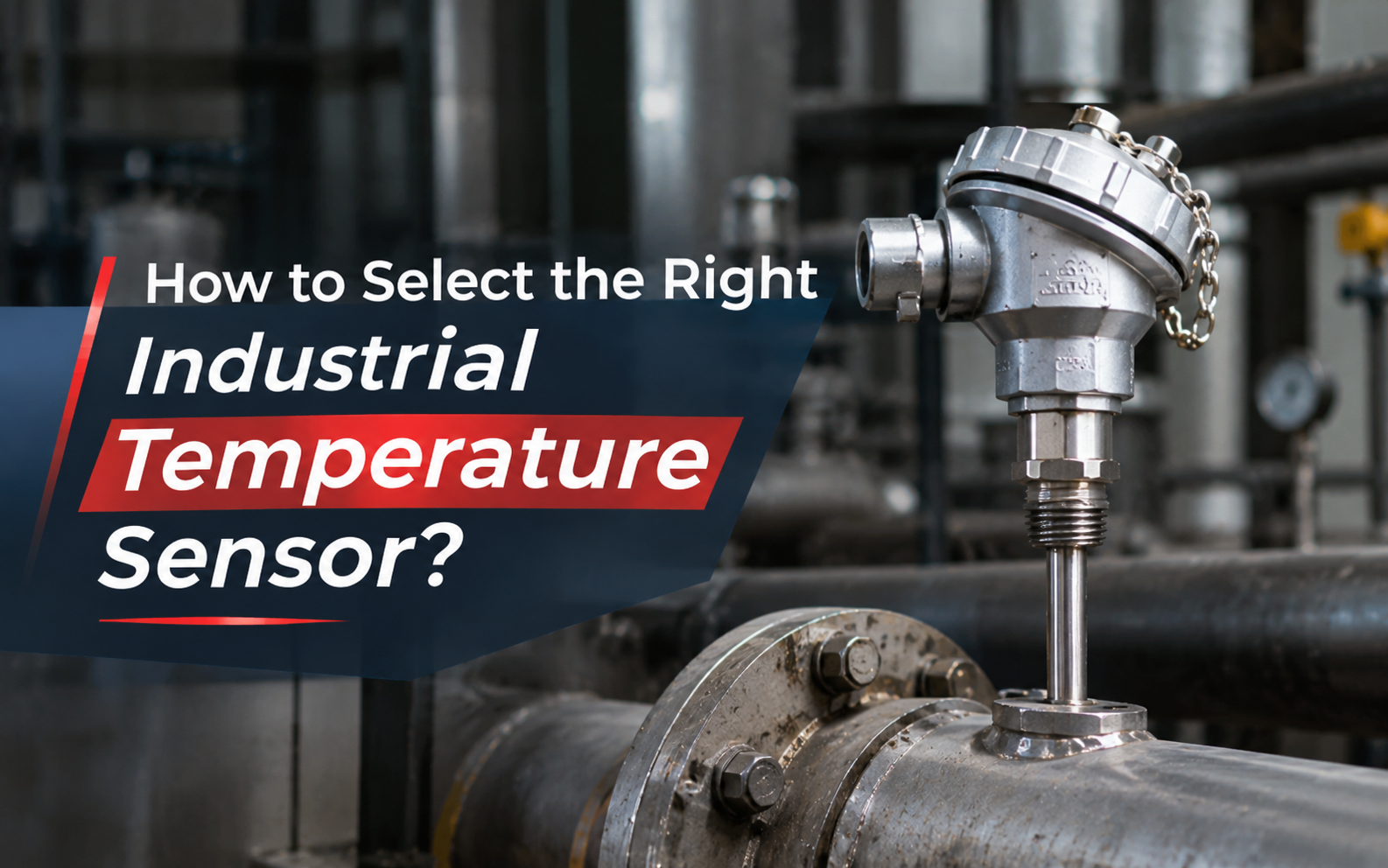
How to Select the Right Industrial Temperature Sensor? Types, Applications & Selection Guide
Temperature measurement plays an important role in maintaining product quality, equipment performance, and process safety in industrial environments. Industries such as chemical manufacturing, pharmaceuticals, food processing, oil and gas, and power generation require accurate temperature monitoring to maintain consistent operating conditions.
Choosing the wrong temperature sensor can result in inaccurate readings, delayed responses,s and unnecessary maintenance. Therefore, selecting the right instrument according to the application is essential.
In this guide, we will explore different industrial temperature sensors, their applications, ns and the important factors to consider before selecting one.
What Is an Industrial Temperature Sensor?
An industrial temperature sensor is a measuring instrument used to detect temperature changes in liquids, gases, machinery,ery and industrial processes.
It converts temperature variations into an electrical signal or measurable output that can be monitored through temperature controllers, PLCs, SCADA, and other automation systems.
These sensors are widely used in manufacturing plants to monitor heating systems, storage tanks, pipelines, furnaces, and processing equipment.
Types of Industrial Temperature Sensors
Different temperature sensors are designed for different operating conditions. Some commonly used technologies include:
1. RTD Temperature Sensor
- Resistance Temperature Detectors (RTDs) measure temperature by detecting changes in the electrical resistance of a sensing element, commonly platinum.
- They are suitable for applications requiring good accuracy, stability, and repeatability.
Applications: Pharmaceutical manufacturing, chemical processing, food production, and industrial equipment monitoring.
2. Thermocouple Temperature Sensor
- Thermocouples use two different metals joined together to generate a small voltage that changes with temperature.
- They are commonly selected for high-temperature applications, furnaces, boilers,s and industrial heating systems.
Applications: Steel plants, power generation, furnaces, es and heavy manufacturing.
3. Thermistor Temperature Sensor
- Thermistors are temperature-sensitive resistors whose electrical resistance changes significantly with temperature.
- They are particularly useful for applications requiring high sensitivity over a relatively limited temperature range.
Applications: HVAC systems, electronic equipment, ent and temperature control systems.
4. Infrared Temperature Sensor
- Infrared sensors measure temperature by detecting infrared energy emitted from an object without requiring direct physical contact.
- They are useful for monitoring moving objects, hot surfaces, and locations where contact measurement is difficult.
Applications: Manufacturing lines, metal processing,ssing and industrial equipment monitoring.
5. Surface Temperature Sensor
Surface temperature sensors measure the temperature of external surfaces without inserting a probe into the process medium.
Applications: Motors, pipelines, machinery, and industrial equipment.
How to Select the Right Industrial Temperature Sensor?
Before purchasing a temperature sensor, evaluate the actual operating conditions and measurement requirements.
1. Temperature Range
Identify the minimum and maximum temperatures the instrument must measure. The selected sensor should support the complete operating range, including possible temperature fluctuations.
2. Required Accuracy
Different applications require different accuracy levels. RTDs are commonly preferred for precision and stability, while thermocouples are suitable for many wider-range and high-temperature applications.
3. Response Time
Some industrial processes experience rapid temperature changes. Select a sensor with an appropriate response time for the process.
4. Operating Environment
Consider vibration, moisture, dust, chemical exposure, and pressure. The sensor's sheath and construction should be compatible with the installation environment.
5. Installation Requirements
Check probe length, mounting arrangement, connection,nnection and whether a thermowell is required to protect the sensing element.
6. Output and Compatibility
Verify whether the temperature sensor needs to connect directly to a controller or through a temperature transmitter. Check signal compatibility, configuration,iguration and communication requirements.
Where Are Industrial Temperature Sensors Used?
Industrial temperature sensors are important across several manufacturing and processing sectors.
-
Chemical Industry: Monitoring temperatures in reactors and chemical processing equipment.
-
Pharmaceutical Industry: Maintaining controlled temperatures during manufacturing and storage.
-
Food and Beverage: Monitoring cooking, heating, cooling, and production processes.
-
Oil and Gas: Measuring temperatures in pipelines, storage systems, and processing equipment.
-
Power Plants: Monitoring boilers, turbines, and other equipment.
-
HVAC Systems: Measuring air and water temperatures for heating and cooling control.
Industrial Temperature Measurement Solutions by Cozum Solutions, Mumbai
Cozum Solutions Pvt. Ltd. is an industrial process engineering, instrumentation, and automation company based in Jogeshwari West, Mumbai, Maharashtra, India.
The company offers a range of industrial temperature measurement products designed for different process and equipment requirements.
Its temperature product category includes:
-
Multipoint Thermometers
-
Cable Probes
-
Compact Thermometers
-
High Temperature Thermometers
-
HVAC/BMS Temperature Sensors
-
Hygienic Thermometers
-
Industrial Thermometers
-
Surface Thermometers
-
Temperature Switches
-
Temperature Transmitters
-
Thermowells
-
Wireless Temperature Transducers and Thermometers
For businesses searching for an industrial temperature sensor supplier in Mumbai, temperature measurement instruments in Maharashtra, or industrial temperature monitoring solutions in India, Cozum Solutions offers multiple product options to explore.
Visit the official website to explore the available temperature measurement products:
https://cozumsolutions.com/Products?slug=temperature-transmitter
Frequently Asked Questions (FAQs)
1. Which temperature sensor is best for industrial applications?
RTDs and thermocouples are commonly used in industrial applications. The right choice depends on temperature range, accuracy, response time, and operating conditions.
2. What is the difference between RTD and thermocouple?
RTDs measure temperature through changes in electrical resistance, while thermocouples generate a voltage based on the temperature difference between two dissimilar metals.
3. Which temperature sensor is suitable for high-temperature applications?
Thermocouples are commonly used for high-temperature applications such as furnace kilns and industrial heating systems.
4. What is a temperature transmitter?
A temperature transmitter converts the sensor's measurement into a standardised output signal, commonly 4–20 mA, for industrial monitoring and control systems.
5. Where can I find industrial temperature sensors in Mumbai?
Cozum Solutions Pvt. Ltd., located in Jogeshwari West, Mumbai, Maharashtra, offers various industrial temperature measurement products and instrumentation solutions.
Conclusion
Selecting the right industrial temperature sensor requires understanding the operating temperature, accuracy requirements, response time, me and installation environment. RTDs, thermocouples, thermistors, and infrared sensors each offer different advantages for specific applications.
For reliable industrial temperature measurement and instrumentation requirements in Mumbai, Maharashtra, and across India, explore the temperature product range offered by Cozum Solutions.
Website: https://cozumsolutions.com/