What Are Level Transmitters? Types, Working Principle, and How to Choose the Right One
In modern industry, accurate level measurement is essential for efficient production, managing storage tanks, and preventing material overflow. Industries dealing with water, chemicals, oil, and wastewater use industrial level measurement instruments to monitor their processes.
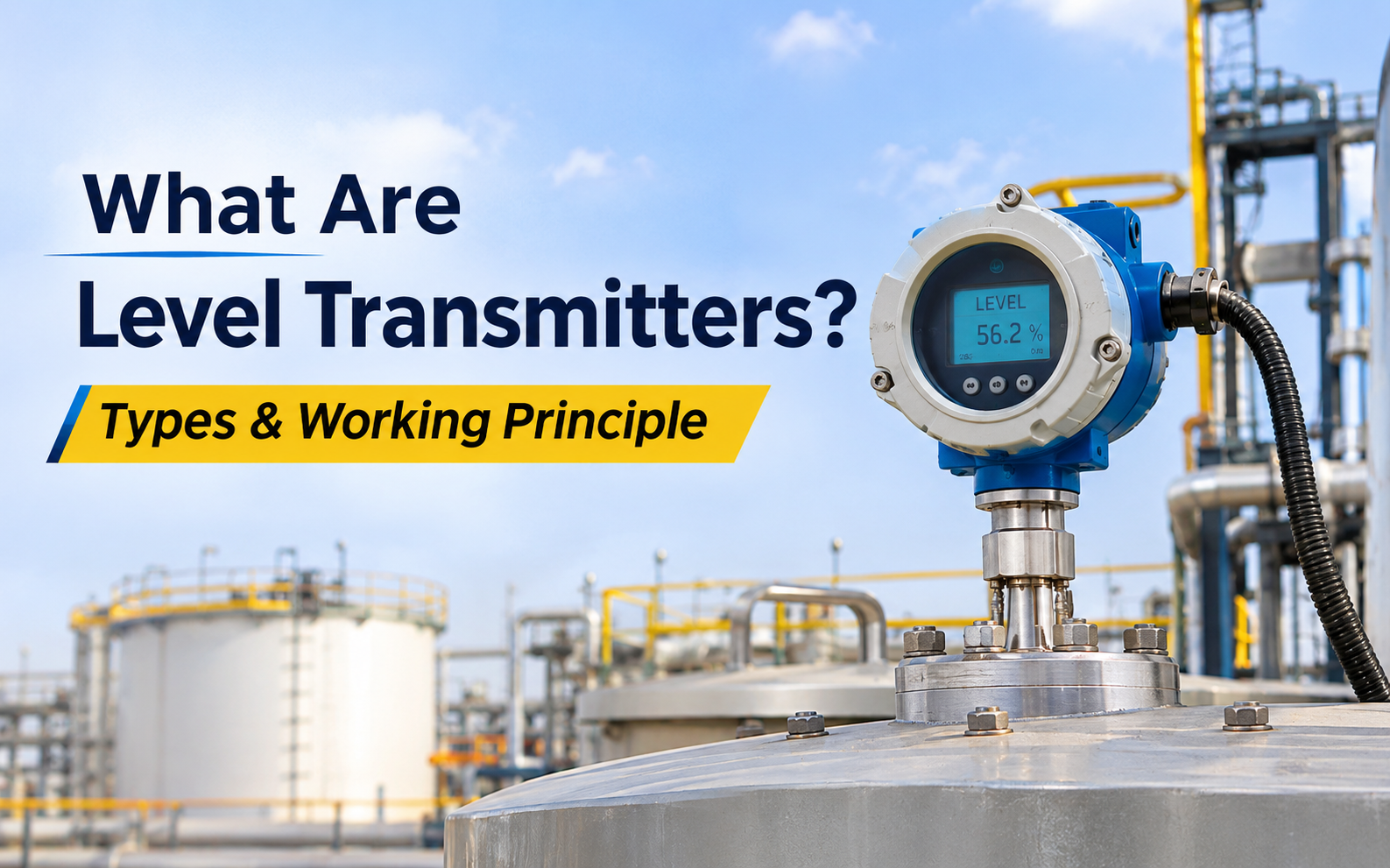
A level transmitter is an industrial instrument that measures the level of liquid or solid material inside a tank, vessel, or silo and sends measurement data to a monitoring or control system.
For businesses looking for industrial instrumentation and level measurement solutions in Mumbai, it's important to understand different transmitter technologies before selecting the right equipment.
What Is a Level Transmitter?
A level transmitter is a device used to continuously measure the level of material inside industrial tanks and storage vessels. It converts the measurement into an electrical or digital signal that can be monitored through PLC, SCADA, or DCS systems.
For example, in a water storage tank, a level transmitter monitors the water level and sends information to the control room. This helps operators manage water supply, control pumps, and prevent overflow.
How Does a Level Transmitter Work?
A level transmitter works by detecting the material level using different measurement technologies, including pressure, radar waves, ultrasonic waves or electrical properties.
The general working process involves three steps:
-
Detection: The sensor identifies the material level.
-
Processing: Internal electronics calculate the actual measurement.
-
Transmission: The measured value is sent to a monitoring system, commonly through a 4–20 mA signal or digital communication.
This process allows industries to monitor tank levels without regular manual inspection.
Types of Level Transmitters
Different industrial applications require different measurement technologies. The commonly used types include:
1. Radar Level Transmitter
Uses electromagnetic waves to measure the distance between the transmitter and the material surface. It is used in chemical plants, oil storage tanks, and industrial processing vessels.
2. Ultrasonic Level Transmitter
Uses high-frequency sound waves to measure material levels. It is commonly used in water tanks, wastewater treatment facilities,s and open-channel applications.
3. Hydrostatic Level Transmitter
Measures the pressure generated by the liquid column. It is suitable for water storage tanks, reservoirs, rs and wastewater applications.
4. Guided Wave Radar Level Transmitter
Uses microwave signals travelling along a probe to detect material levels. It is used in chemical processing, liquid storage, and certain interface measurement applications.
5. Differential Pressure Level Transmitter
Measures the pressure difference between two points to calculate liquid level. It is commonly used in pressurised vessels and industrial process tanks.
6. Capacitance Level Transmitter
Measures changes in electrical capacitance as the material level changes around a sensing probe. It is used in suitable liquid and bulk-solid applications.
Where Are Level Transmitters Used?
Level transmitters support measurement and process monitoring across multiple industries.
-
Water and wastewater treatment plants
-
Chemical and pharmaceutical industries
-
Oil and gas storage facilities
-
Food and beverage manufacturing
-
Power generation plants
-
Cement and mining industries
They help improve process monitoring, material management, and operational efficiency.
How to Choose the Right Level Transmitter?
Selecting the correct instrument depends on the application and operating environment. Consider these important factors:
-
Material Type: Identify whether the application involves water, oil, chemicals, slurry, or solid materials.
-
Measurement Range: Check the tank dimensions and required measuring range.
-
Temperature and Pressure: Verify the instrument's operating limits.
-
Environmental Conditions: Consider foam, vapour, dust, and condensation.
-
Output Signal: Ensure compatibility with PLC, SC DA, A or other control systems.
-
Installation Requirements: Evaluate mounting position, process connections, n,s and material compatibility.
-
Maintenance: Review calibration requirements and long-term maintenance needs.
A proper technical assessment helps avoid incorrect selection and improves measurement reliability.
Industrial Level Measurement Solutions by Cozum Solutions, Mumbai
Cozum Solutions Pvt. Ltd. is an industrial process engineering and instrumentation company located in Jogeshwari West, Mumbai, Maharashtra, India.
The company provides industrial instrumentation, automation technologies, and engineering solutions for different manufacturing sectors.
Its level measurement product category includes various technologies such as radar, ultrasonic, hydrostatic, guided radar, capacitance, conductive, and other level measurement solutions.
For businesses searching for a level transmitter supplier in Mumbai, industrial instrumentation in Maharashtra, or level measurement solutions in India, Cozum Solutions offers a range of product options for different industrial requirements.
Explore the available products: https://cozumsolutions.com/products
Frequently Asked Questions (FAQs)
1. What is the main purpose of a level transmitter?
It continuously measures the level of material inside a tank, vessel, or silo and sends the measurement to a monitoring system.
2. Which level transmitter is suitable for water tanks?
Hydrostatic and ultrasonic transmitters are commonly considered for water tank applications, depending on installation and operating conditions.
3. What is the difference between radar and ultrasonic level transmitters?
Radar uses electromagnetic waves, whereas ultrasonic transmitters use sound waves to measure material levels.
4. What output signal is commonly used in level transmitters?
A 4–20 mA signal is widely used in industrial applications. Some instruments also support HART and digital communication protocols.
5. Where can I find industrial level measurement solutions in Mumbai?
Cozum Solutions Pvt. Ltd., located in Jogeshwari West, Mumbai, provides industrial instrumentation and level measurement product options.
Conclusion
Level transmitters are important instruments for accurate material monitoring and industrial process control. Understanding their types, working principles, and selection factors helps businesses choose suitable measurement technologies.
For industrial instrumentation and level measurement solutions in Mumbai, Maharashtra, and across India, explore the product range at Cozum Solutions.
Website: https://cozumsolutions.com/